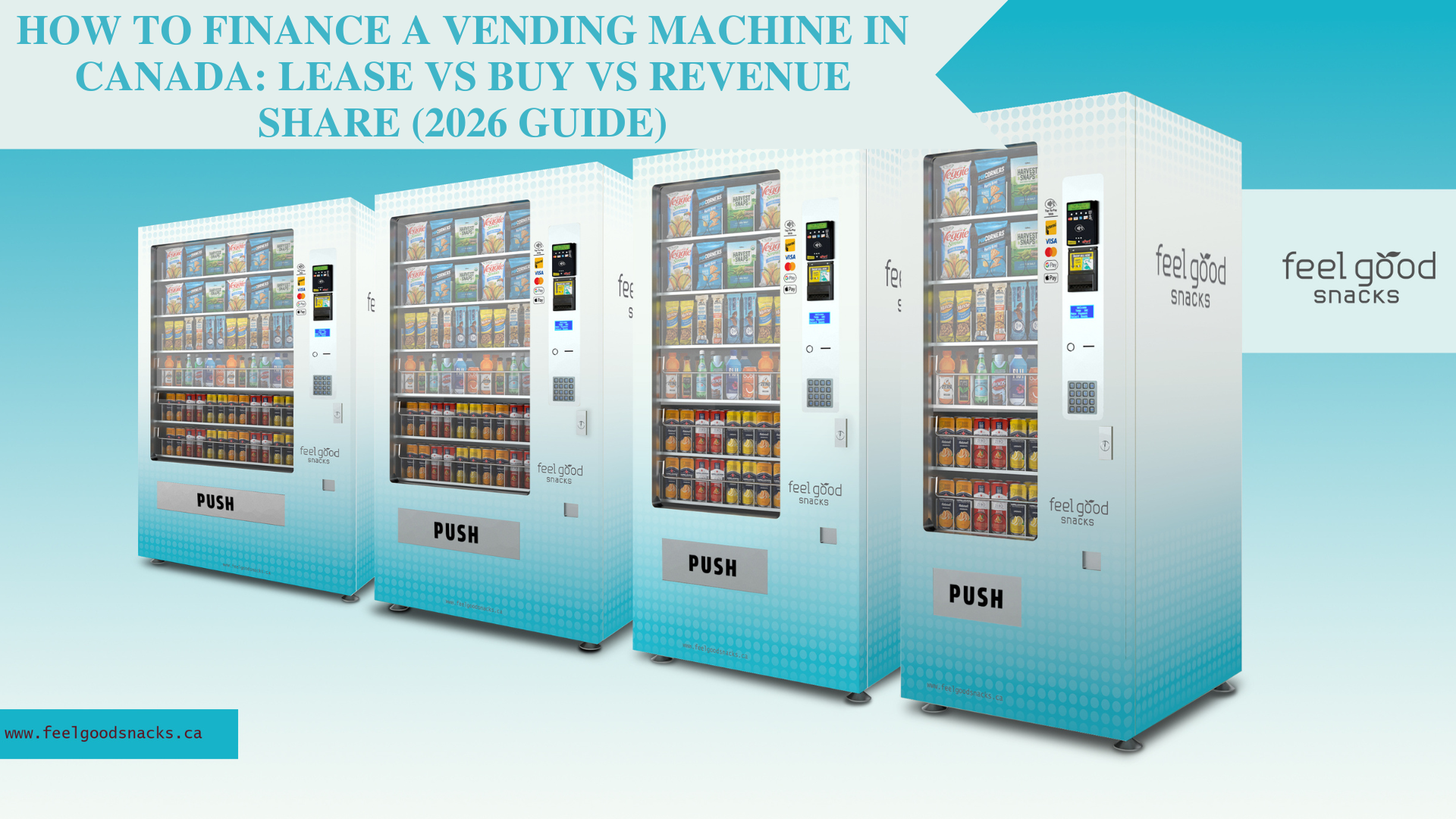
Should you lease a vending machine or buy it outright? It’s the first big decision for most new operators in Canada, and the right answer depends on how much cash you have, how quickly you want to grow and whether you want a new or refurbished machine. This guide compares vending machine leasing, buying with cash and Canadian small-business loans side by side, using real lease-to-own terms and a worked example on a $4,499 combo machine — so you can see the true cost of each option before you sign anything.
- Vending machine lease-to-own through Feel Good Snacks’ third-party partner covers any new machine: 24, 36, 48 or 60 months, first and last payment upfront, 8–12% interest depending on term, and a $10 or 10% buy-out.
- Buying outright is the cheapest total cost and the only route for refurbished machines, which start from about $3,000.
- Illustrative example: a $4,499 combo at 10% is about $145.17 a month over 36 months or $114.11 over 48 months — costing $727.12 or $978.28 in financing versus paying cash.
- Bank loans, BDC and the CSBFP are the main Canadian loan routes; most lenders look at personal credit and may want a personal guarantee for a new business.
- Revenue-share or free-placement vending is a different business: someone else owns the machine and you only earn a commission.
- Vending machine lease vs buy: the short answer
- How vending machine leasing works
- Buying a vending machine outright
- Vending machine financing with a loan
- Lease vs buy vs loan comparison
- Worked example: cash vs 36 vs 48 months
- Tax: lease vs purchase
- Revenue-share and free placement
- When to lease, when to buy
- Decision checklist
- FAQ
Vending machine lease vs buy: the short answer
Buy if you have the cash, want the lowest total cost, or want a refurbished machine. Lease if you want a new vending machine without tying up $4,500 or more, want to keep cash for inventory and a second location, or want the machine to help pay for itself from day one. Borrow from a bank, BDC or through the Canada Small Business Financing Program if you’re buying several machines at once and can qualify for a better rate.
None of these is universally right. A lease costs more in total because you’re paying interest, but it changes your cash flow dramatically: instead of $4,499 out the door, you pay two monthly payments on approval and let the machine’s sales cover the rest. If you haven’t priced the full setup yet, start with our guide to how much a vending machine costs in Canada, then come back here to decide how to pay for it.
How vending machine leasing works with Feel Good Snacks
Feel Good Snacks offers third-party lease-to-own financing on any new vending machine in our range. “Lease-to-own” means you make fixed monthly payments for an agreed term and then take ownership for a small buy-out at the end, rather than handing the machine back. The financing is provided by a third-party lender, and approval is based on their review of your application.
| Term | What it means for you |
|---|---|
| Lease length | 24, 36, 48 or 60 months |
| Due on approval | First and last month’s payment upfront |
| Interest rate | From 8% to 12%, depending on lease length and terms (approval-based) |
| End of lease | Buy-out option of $10 or 10% |
| Eligible machines | New machines only — refurbished machines are bought outright |
Shorter terms usually come with lower rates and lower total interest but higher monthly payments; longer terms lower the monthly payment but add more interest over the life of the lease. The buy-out structure your agreement uses — $10 or 10% — also changes the final total, so read it carefully.
What a vending machine lease covers and doesn’t
A lease finances the machine. Budget separately for delivery and installation ($350–$700, higher outside the GTA), your first inventory fill (~$250–$400 for a typical combo), business setup (~$300–$800) and insurance, unless your approval says otherwise. You are responsible for stocking, servicing and insuring the machine during the lease, the same as if you owned it outright.
Leasing is available on new machines such as the FGS Gris, Elite et Série Terre combos ($4,499), dedicated snack, drink and sandwich machines (~$5,499) and frozen machines (~$7,999). Browse all distributeurs automatiques à vendre.
Buying a vending machine outright
Paying cash is the simplest option and always the cheapest in total. There’s no interest, no approval process, no monthly payment, and every dollar the machine earns after it pays back is yours. It’s also the only way to get a refurbished machine, which starts from about $3,000 — often the smartest first purchase for a location you’ve already proven.
The trade-off is liquidity. A new combo at $4,499 plus delivery, first stock and setup can take $5,800 or more out of your bank account on day one. If that leaves you without a cushion for a slow first month, a repair or a second location that comes up unexpectedly, the “cheapest” option can slow your growth. Many operators split the difference: buy the first refurbished machine with cash, then lease new machines as the route grows.
Compare current refurbished vending machines for sale, read refurbished vs new vending machines, or see what to check in used vending machines for sale.
Vending machine financing with a bank, BDC or CSBFP loan
If you’re buying several machines or want to finance delivery and inventory as well as equipment, a business loan is worth comparing with a lease. The main Canadian routes:
- Canada Small Business Financing Program (CSBFP): government-backed loans made through participating banks and credit unions, usable for equipment. Limits and fees change, so check the official CSBFP page for current details.
- BDC (Business Development Bank of Canada): a federal Crown corporation that lends to small businesses and start-ups. See bdc.ca.
- Bank small-business loans and lines of credit: your own bank or credit union may offer equipment loans or a business line of credit, especially if you already bank with them.
- Credit cards and personal lines of credit: fast and easy, but usually at much higher interest. Use them only for small gaps you can pay off quickly.
For a brand-new business with no track record, lenders typically look at your personal credit, and many will ask for a personal guarantee. A short business plan showing your location, expected sales and costs helps — our vending machine business plan guide shows what to include. For a deeper walk-through of every route, read how to finance a vending machine purchase in Canada.
Vending machine lease vs buy vs loan: side-by-side comparison
| Buy outright (cash) | Lease-to-own (FGS partner) | Bank / BDC / CSBFP loan | |
|---|---|---|---|
| Upfront cash | Full price (from ~$3,000 refurbished, $4,499+ new) | First + last month’s payment | Down payment varies by lender |
| Monthly cost | None | Fixed payment for 24–60 months | Fixed loan payment |
| Total cost | Lowest — no interest | Machine + interest (8–12%) + buy-out | Machine + interest + any fees |
| Ownership | Yours immediately | Yours after the $10 or 10% buy-out | Yours; lender may hold security |
| Tax treatment (general) | Depreciated through CCA | Often treated like a purchase — confirm | Machine via CCA; interest generally deductible |
| Flexibilité | Highest — sell or move freely | Committed to the full term | Committed to loan terms |
| Machines | New or refurbished | New only | New or refurbished |
| Approval | None | Third-party lender review | Credit review; may need guarantee |
| Best for | Cash-ready buyers, refurbished first machines | New machines while keeping cash free | Multi-machine purchases, established credit |
Tax treatment varies with how each agreement is structured, so treat that row as general guidance only — see the tax section below and confirm with your accountant.
Worked example: $4,499 combo — cash vs 36- and 48-month lease
To make the trade-off concrete, here’s an illustrative example using a new $4,499 combo machine and a 10% interest rate, which sits in the middle of the 8–12% range. The monthly payment uses the standard amortized loan formula — payment = price × r ÷ (1 − (1 + r)−n), where r is the annual rate divided by 12 and n is the number of months. This is not a quote: actual payments depend on your approval, the lender’s method, taxes and fees.
| Buy with cash | 36-month lease at 10% | 48-month lease at 10% | |
|---|---|---|---|
| Machine price | $4,499.00 | $4,499.00 | $4,499.00 |
| Monthly payment | — | $145.17 | $114.11 |
| Due upfront | $4,499.00 | $290.34 (first + last) | $228.22 (first + last) |
| Number of payments | — | 36 | 48 |
| Total of payments | $4,499.00 | $5,226.12 | $5,477.28 |
| Cost of financing (vs cash) | $0 | $727.12 | $978.28 |
| Total incl. $10 buy-out | $4,499.00 | $5,236.12 | $5,487.28 |
| Total incl. 10% buy-out ($449.90) | $4,499.00 | $5,676.02 | $5,927.18 |
The checks: 36 × $145.17 = $5,226.12 and 48 × $114.11 = $5,477.28. The first and last payments are part of those totals — you’re paying them early, not on top. At the ends of the rate range, the 36-month payment would be about $140.98 at 8% or $149.43 at 12%, and the 48-month payment about $109.83 at 8% or $118.48 at 12%. All figures are before sales tax and any lender fees.
What it does to payback
Now assume the machine nets about $300 a month after product and running costs — an estimate within the $250–$400 a well-placed machine typically earns, not a guarantee.
| Buy with cash | 36-month lease | 48-month lease | |
|---|---|---|---|
| Net monthly earnings (estimate) | $300.00 | $300.00 | $300.00 |
| Less machine payment | $0 | −$145.17 | −$114.11 |
| Cash left each month | $300.00 | $154.83 | $185.89 |
| Upfront machine cash recovered in | ~15 months ($4,499 ÷ $300) | ~1.9 months ($290.34 ÷ $154.83) | ~1.2 months ($228.22 ÷ $185.89) |
This is the heart of the lease vs buy decision. The cash buyer waits about 15 months to get the machine money back but keeps the full $300 every month after that. The leasing operator gets their small upfront payment back within two months and is cash-flow positive almost immediately, but hands $145.17 or $114.11 of each month’s earnings to the lender until the term ends. By the end of the term, the cash buyer is ahead by exactly the financing cost — $727.12 over 36 months or $978.28 over 48 months, plus any buy-out.
If the cash you didn’t spend goes into a second machine in a good location, that second machine can easily earn more than the interest on the first. If it would just sit in your account, buying outright is the better deal. Run your own figures in the Vending Machine ROI Calculator.
Tax treatment: leasing vs buying a vending machine
Here is the general picture in Canada — confirm how your specific agreement is treated with your accountant before you rely on it.
- Purchased machines (cash or loan) are depreciable assets. Instead of deducting the full price in year one, you claim Capital Cost Allowance (CCA) over several years. Interest on a business loan is generally deductible.
- A true lease — where you rent the machine and give it back — generally lets you deduct the payments as an operating expense.
- Lease-to-own agreements with a nominal buy-out may be treated more like a purchase than a rental, which affects whether you claim payments or CCA.
- GST/HST applies to the machine price or lease payments. Registration is required once taxable sales pass $30,000 over four consecutive quarters; registered businesses can generally recover the tax they pay on business purchases.
Read are vending machines tax deductible in Canada? for more, and bring your lease or loan documents to your accountant.
What about revenue-share or free-placement vending?
You’ll see “free vending machine” or “revenue share” offers online. In a typical revenue-share or free-placement arrangement, a full-service vending company owns the machine, places it at a business, stocks and services it, and pays the location a share of sales as commission. The business hosting the machine pays nothing — but it doesn’t own anything either.
That’s a great deal for a location owner who simply wants a machine on site. It is not a way to start a vending business. If you’re the one who wants to earn from vending, you’re on the operator side of that arrangement: you buy or lease the machine, find the location, keep it stocked and decide what commission, if any, to offer. See our guide to how much commission to pay location owners.
Some operators also hear about financing that is repaid as a percentage of sales. Terms vary widely and can be expensive; compare the total cost against a fixed-payment lease or loan before agreeing to anything.
When to lease a vending machine and when to buy
Lease when…
You want a new machine with cashless and telemetry but don’t want to tie up $4,500–$8,000; you’d rather keep cash for inventory, delivery and a second site; your location is confirmed and should cover the payment; and you’re comfortable committing to a 24–60 month term.
Buy when…
You have the cash without draining your emergency cushion; you want the lowest total cost; you’re buying a refurbished machine from ~$3,000; or you’re testing an unproven location and want the freedom to move or sell the machine without a contract.
Borrow when…
You’re buying several machines at once, you have solid personal credit, and a bank, BDC or CSBFP-backed loan offers a better overall rate than leasing each machine separately.
Wait when…
You don’t have a location yet. No financing decision matters until you know where the machine is going and roughly what it will sell. Secure the site first, then choose how to pay.
Vending machine lease vs buy: decision checklist
- Have you secured a location? Get written agreement from the host before you buy or lease.
- New or refurbished? Leasing is for new machines; refurbished means paying outright.
- How much cash can you spare after keeping a cushion for stock, repairs and slow months?
- What will the machine realistically net? Use the ROI Calculator et what a vending machine makes per month.
- Does net earnings comfortably exceed the monthly payment? Leave room for a weaker month.
- What’s the total cost? Multiply the payment by the term and add the buy-out, then compare with the cash price.
- Which buy-out applies — $10 or 10% — and when can you exercise it?
- What’s excluded? Delivery, first fill, setup and insurance are usually separate.
- Have you asked your accountant how the agreement will be treated for tax?
Want a second opinion? Book a free one-hour consultation and we’ll walk through your location, budget and the numbers for buying versus leasing. Or browse our distributeurs automatiques à vendre and the full vending machine cost guide.
Frequently asked questions
Can you lease a vending machine in Canada?
Yes. Feel Good Snacks offers third-party lease-to-own financing on any new vending machine, with terms of 24, 36, 48 or 60 months, first and last month’s payment upfront on approval, interest from 8% to 12% depending on term, and a $10 or 10% buy-out at the end.
How much is a vending machine lease per month?
It depends on the machine, term and approved rate. As an illustrative example only, a $4,499 combo at 10% works out to about $145.17 a month over 36 months or $114.11 over 48 months using a standard amortized payment, before taxes and fees. Your actual payment is set on approval.
Is it better to lease or buy a vending machine?
Buying is cheaper in total because there’s no interest, and it’s the only option for refurbished machines. Leasing costs more overall but needs far less cash upfront, so it suits operators who want a new machine and want to keep cash free for inventory or a second location.
Can I lease a refurbished vending machine?
Lease-to-own financing through Feel Good Snacks applies to new machines. Refurbished machines, which start from about $3,000, are bought outright.
What do I need to qualify for vending machine financing?
Approval is set by the third-party lender or bank. For a new business, lenders typically review your personal credit and may ask for a personal guarantee. Having a confirmed location and a simple plan showing expected sales and costs helps.
Are vending machine lease payments tax deductible?
Payments on a true lease are generally deductible as an operating expense, while purchased machines are written off through Capital Cost Allowance. Lease-to-own agreements may be treated like a purchase. Confirm your situation with an accountant.
What is a revenue-share vending machine?
In a revenue-share or free-placement setup, a vending company owns and services the machine and pays the host location a commission on sales. It suits location owners, but you don’t own the machine — to run your own vending business, you buy or lease the machine yourself.
Keep reading
Quel est le coût d'un distributeur automatique au Canada ?
Read the guide →
How to Finance a Vending Machine Purchase
Read the guide →
Lease or buy — let’s run your numbers
Feel Good Snacks has new and refurbished vending machines for sale across Canada, with lease-to-own financing on new machines. Tell us about your location and budget and we’ll help you choose.